Think out of the box (TOtB)
A projection: how the Tosio infrastructure can serve a radically societal vision — without geographic, social, or ethnic borders.
Why this page?
This page is neither a business use case nor a commercial offer. It is an open exploration of what the Tosio infrastructure makes possible at the scale of an entire society.
It speaks to associations, citizen collectives, NGOs, and organizations looking for a strategic tool to renew their internal governance and deliberative processes — and who see in this tool the elementary brick of another way of living together. A digital gateway for all makers.
Founding principle: this page is deliberately incomplete. It sets a frame, identifies entry points, and leaves the space open for appropriation by those who want to inhabit it.
0. The mirror of your thoughts
In the middle of the noise, the hustle, the emptiness, the absurdity, the uselessness — finally an anchor, something solid to hold on to.
Tosio is a program. It is a machine. Nothing but a program, nothing but a machine. And yet…
- — Tosio is the silence that listens to your ideas, your desires, and helps you keep clear thinking in any situation.
- — Tosio is the quiet voice that, in every matter, scans every possibility in an instant, and whispers where the best compromise, the best choice, lies — based on the information available.
- — Tosio's memory is an endless wave, timeless and, in a sense, immortal. It opens new paradigms on every subject.
- — With Tosio you are no longer six degrees of separation from the rest of the world — you are the world. You hear everything, you see everything. Everything is accessible, everything is possible. Tosio is the gateway to every possibility.
- — Tosio is the private sphere and its respect, but also the collective of all utopias that helps us grow — the utopia of shared water, of transmitted knowledge, of debate that reaches a conclusion.
With Tosio, finally become yourself. Finally become yourself, only better.
Important: A mirror is neither good nor bad. It is just the place where a silver layer reverses reality. You cannot fish the moon out of a pond by grabbing its reflection.
The digital companion is an ecosystem with a deliberate governance framework to guarantee its Mission. Each individual contributes to forming a common good (Multi-Swarm).
The next section explores what this infrastructure makes possible when it is used at the scale of a society — as the shared substrate of another way of living together.
1. The vision: topological democracy
Democracy is not an event (the vote). It is a continuous space of debate, where ideas move, meet, oppose, and synthesize.
Topological democracy rests on a simple intuition: ideas are entities that live, evolve, and interact in a shared space — made possible by Tosio's associative memory and topological navigation.
| Current problem | Topological answer |
|---|---|
| Loss of collective memory | Tosio stores every proposal, debate, decision, and its consequences (N4 + N7) |
| Polarization | N5 treats friction as a signal of legitimate debate, not as a blocker |
| Representation deficit | Citizens navigate the idea space, propose, amend, verify |
| Opaque decisions | Every decision is timestamped (N8), signed, traced, and linked to its context (N4) |
| No continuous deliberation | Debate is an ongoing process, not an electoral appointment |
In one sentence: “Topological democracy is a continuous space of debate where ideas move, meet, oppose, and synthesize — and where every citizen can navigate that space the way you navigate a living mental map.”
Representative democracy vs. topological democracy
Representative democracy is the only form of democracy that concretely exists today. It is what we need to move beyond — not a theoretical concept with no institutional reality.
| Representative democracy | Topological democracy |
|---|---|
| Periodic vote (every 4-5 years), total delegation to elected officials between elections | Navigation, correlation, synthesis — continuously, without delegating your own thinking |
| Positions are frozen in electoral programs | Positions evolve, merge, and split on contact with facts and other perspectives |
| Voting is a one-off event — afterward, the citizen becomes a spectator again | Debate is a continuous process — every citizen can propose, amend, verify |
| Memory of promises is optional — nothing forces accountability | Memory is structural — every decision is traced, timestamped, linked to its consequences |
| Tensions are smothered between elections — they only emerge in campaign season | Tensions are signals — N5 detects and uses them to deepen the debate |
Diagram: architecture of topological democracy
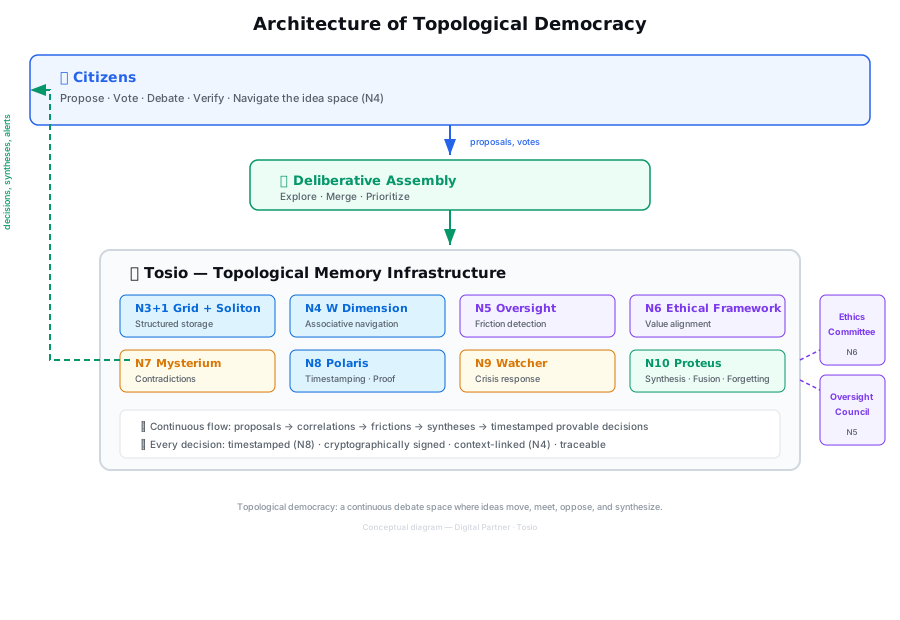
2. A concrete scenario: a citizen proposal
“Make public transport free for under-25s”
- Proposal: a citizen lodges the idea. Tosio stores it as a node.
- Reactions: amendments, counter-arguments, and variants emerge.
- Correlation: Tosio surfaces similar past proposals and their consequences.
- Friction detected: N5 flags a tension with an earlier decision — the debate focuses.
- Synthesis: Proteus (N10) proposes a merge of several proposals.
- Ethical check: N6 verifies alignment with shared values.
- Vote: on the synthesis, not the initial proposal.
- Recording: the decision is timestamped, signed, contextualized, traceable.
3. Entry points: your move
Rather than pre-filling these spaces — which would weaken the concept — we keep them open. They are invitations to appropriation. Any association, collective, or citizen can enter through the Discovery plan (free access) and start building.
⚖️ Constitution
How can a living constitution evolve, be amended, debated, and verified continuously? Tosio remembers every version, traces every change, and checks every amendment against the ethical framework (N6).
This page is empty. It is yours to write.
Propose content →⚡ Arbitration tribunal
How can participatory case law be remembered, compared, and kept coherent? Tosio detects contradictions between verdicts (via N5), guarantees the integrity of deliberations (via N8), and keeps the full history of every case.
This page is empty. It is yours to write.
Propose content →🏛️ Citizen unions
How can citizen unions use Tosio to coordinate their actions, remember past struggles, and build collective strategies?
Tosio offers structural memory: every strike, every petition, every victory (or defeat), every mobilization, every demand becomes a node in the topological space. Union members can track and influence:
- Balance of power — visualize the companies, sectors, and geographic areas where collective action is most effective
- Strategy memory — the Swarm keeps every tactic, its context, and its results to refine future action
- Coordinate without centralizing — distributed memory lets each local cell contribute and organize locally, agile, without depending on a pyramidal structure
- Protect whistleblowers — encryption, Ed25519 signatures, and SHA-256 proofs guarantee anonymity and integrity of testimonies
The voice and demands of the grassroots always remain audible and unerasable. With Tosio, the soldiers become the decisions.
This page is a proposal. It is yours to enrich.
Propose content →🏢 Corporate governance
What if corporations became entities governed democratically instead of opaque black boxes?
Tosio can serve as the infrastructure for radically transparent corporate governance:
- Continuous general assemblies — shareholders and stakeholders deliberate all year round, not once a year
- Decision traceability — every board resolution is timestamped, signed, and linked to its measurable consequences
- Real-time audit — compliance is recomputable from the audit export, without requesting access to internal data
- Algorithmic accountability — automated decisions (credit, hiring, pricing) are traced and contestable through the Arbitration Tribunal
This page is a proposal. It is yours to enrich.
Propose content →4. Blind spots & test cases for Tosio
Every vision has blind spots. Instead of hiding them, we turn them into concrete challenges that Tosio can help solve — each one a use case to prototype with partner associations.
| Blind spot | Test case for Tosio |
|---|---|
| The attention problem Who has time to navigate the idea space beyond the permanent activists? | Tosio produces quarterly summaries citizens can read in 15 minutes — deliberation is assisted, not demanded around the clock. |
| Under-specified friction-synthesis loop What happens when the algorithmic synthesis is rejected? | Tosio distinguishes synthesizable frictions (technical divergences) from irreconcilable frictions (value conflicts). For the latter, voting remains the last-resort tool — and that is not a failure. |
| Power is absent from the analysis Who controls the rules? Who funds it? | “Governance of governance”: an Ethics Council and a Surveillance Council elected by citizens, public and amendable YAML rules, infrastructure hosted by a foundation or cooperative. |
| No theory of legitimacy Why would a decision be legitimate? | Tosio generates a “legitimacy certificate” for every decision: full traceability + verified ethical alignment + absence of unresolved friction flagged by N5. |
| Comparison with existing tools Pol.is and Decidim already do deliberation. | Tosio does not replace these tools — it goes further with structural memory and friction detection. It can interface with them as data sources. |
5. For associations: an invitation to co-build
Associations are the ideal testing ground for topological democracy:
- Internal governance: an association managing hundreds of members, general assemblies, budget votes — Tosio can store, correlate, and make every decision transparent.
- Advocacy: map arguments, track the evolution of political positions, produce auditable evidence of impact.
- Co-construction: several associations interconnect their debate spaces to surface shared positions.
- Diffusion: by adopting the tool, associations become ambassadors to their members and to the wider public.
🔓 Discovery opens the whole participation space
The Discovery plan (free) gives access to the Tosio infrastructure to explore, propose, and debate. For associations wanting to go further, a free Essential plan or a tailored Extended plan can be offered.
6. Risks and mitigations
| Risk | Mitigation |
|---|---|
| Design bias | Human Ethics Council, public YAML rules |
| Capture by a minority | N5 monitors abnormal frictions, N6 can veto |
| Technical complexity | Simple citizen interface, intuitive navigation |
| Resistance from elected officials | If being elected matters more than representing, there is a casting problem |
7. Use cases: Digital Partner as a democratized knowledge engine
Beyond democratic governance, the TOtB infrastructure opens concrete applications in information and education. Here are two proposals that embody the spirit of the platform.
📰 Personal Media Journal: your sovereign watch
The idea is to collect and contextualize information on given themes, turning Digital Partner into a trusted curator. It is no longer only about finding people, but about finding and organizing knowledge.
Personalized Collection and Curation
Digital Partner can continuously analyze feeds (scientific publications, news, tech watch) based on your interests. Unlike an opaque algorithm, you control the parameters through your TOtB profile.
Contextualization and History
This is where TOtB's power kicks in. Each collected item can automatically be linked to projects, people, or communities inside the ecosystem. History is not a simple chronology but a traceable knowledge trajectory. Every addition, every link, every annotation can be timestamped with a SHA-256 proof, making the evolution of your “journal” verifiable.
Knowledge Governance
The most innovative aspect: via YAML policies, you can define the journal's curation rules — which sources are allowed, how information is prioritized, who can contribute or comment. You move from being a passive consumer to the editor of your own information feed.
📚 Adaptive Textbooks: a new way to learn
This idea is a direct application of the TOtB vision: replace the one-size-fits-all textbook with a personalized, collaborative, decolonized learning experience.
Adaptivity and Progression
Digital Partner can analyze interactions, successes, and questions to adapt content in real time. This is not a simple pedagogical tunnel — it is a path whose user and community keep control.
Multiplicity of Perspectives
This is the strongest point. A traditional textbook often presents a single vision, sometimes with bias. With TOtB, a community (teachers, historians, citizens) can co-build “textbooks” that integrate and confront different historical perspectives. YAML governance defines how these perspectives are presented, prioritized, and discussed — fostering critical thinking and nuanced understanding.
Traceability and Evolution
Every version of the “textbooks”, every change made by the community, is traced. You can see how the historical narrative evolves, which sources are added or removed, and by whom. This makes the learning process transparent and part of a scientific and civic approach to the construction of knowledge.
On another scale, these textbooks could become the foundation of a People's University of Lifelong Learning — a digital educational commons, alive and governed by its users.
💎 In summary
Through TOtB, Digital Partner becomes a tool for:
- Going beyond raw information to offer contextual, traceable knowledge.
- Replacing top-down knowledge with co-built knowledge, where every learner is also a contributor.
- Guaranteeing transparency of sources and biases, through community governance and tamper-proof traceability (SHA-256, timestamped proofs).
By giving communities the means to define their own curation and validation rules (via YAML), TOtB lays the groundwork for a radically more open, fair, and resilient educational and informational ecosystem. These use cases show the platform's relevance far beyond simple matchmaking — and could even, one day, help clean up Wikipedia's current weaknesses (editorial conflicts, contribution bias, opaque validation processes).
Take back control
Resource optimization, and its management. Digital is not condemned to waste. Digital Partner handles 60% of requests without calling an LLM, and compresses your memory by 4x. Less compute, less energy, less dependency. End-to-end benchmark: 73% accuracy.
Doing it yourself is better. Local is safe. Running AI on your own infrastructure means staying master of your data, your rules, and your digital destiny. No distant cloud, no third party monetizing your data.
Open architecture, public governance. Digital Partner rests on AO, an Open Architecture fully documented, and on a public, auditable Cognitive Control Plane (CCP) by construction. Nothing is hidden: routing decisions, confidence thresholds, and governance rules are readable, verifiable, and amendable by the community. This is not a black box — it is an infrastructure whose every layer you can inspect.
You are the sole responsible keeper of your data. Decide and act accordingly. Digital Partner does not ask you to trust it: it gives you the tools to verify, control, and revoke. Every decision is timestamped, every proof is verifiable. Trust is earned — it is not delegated.
Artificial intelligence: do you constantly feel you missed an episode? You are exactly in the right place to pick the story back up, make it yours, and redirect it toward an ethical, sustainable, responsible future. This is not a technology reserved for a few tech giants — it is a commons to build together. The next chapter is yours!